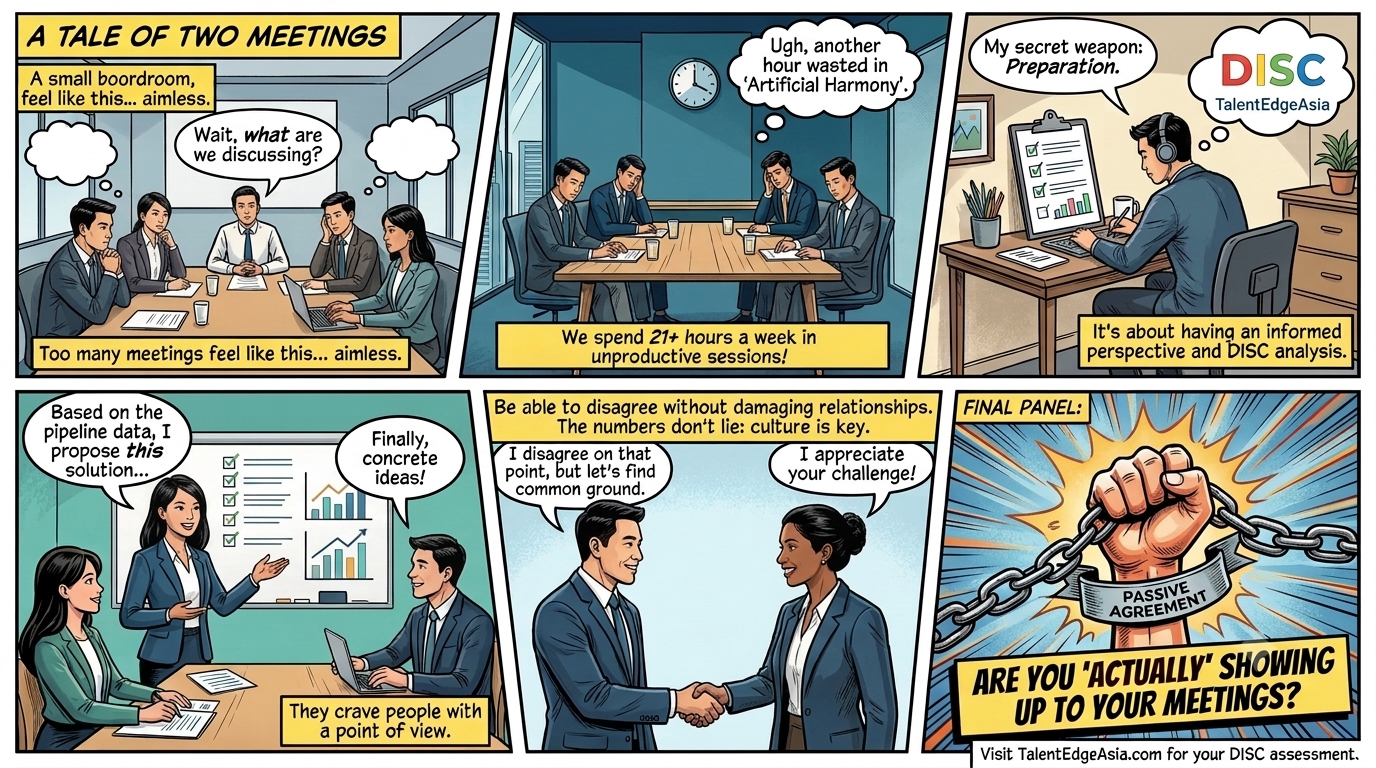
Two of the world's most powerful CEOs just agreed on something most of us already feel but rarely say out loud.
AT&T's John Stankey and JPMorgan's Jamie Dimon sat down with LinkedIn Editor-in-Chief Daniel Roth to celebrate 125 years of their companies' partnership — and the conversation quickly turned to what makes meetings worth having. Watch the full interview here.
Stankey was direct: "I love discourse." But he was equally clear about what that means: "Don't walk in there and just be an observer. When you have a point of view, it shouldn't just be some uninformed opinion. It should be a point of view that's built on facts, information, and data."
Dimon added: "I am never upset when someone says I'm wrong about something. I just want to do the best I can for our clients, our country, our company."
Here's what struck me most as a performance coach.
Stankey openly admitted that his own height and voice make people hesitant to challenge him in meetings — calling it "probably one of the weaker areas" of his leadership. A global CEO. Publicly acknowledging that his physical presence creates a room where people hold back.
If that happens at the top of AT&T, imagine how often it happens in your organisation. In our coaching work, we call this artificial harmony — the room looks aligned, everyone nods, and nothing actually changes. The silence isn't agreement. It's avoidance.
Even CEOs Use AI to Prepare for Meetings Now
Stankey: "I'm starting to wonder if reading is the best way to go. As I've gotten more into the dialog dynamic with AI, I can consume, I think, faster now in a directed conversation."
Dimon: "I use Gemini or Google, and deep dive to get information very quickly. I try to do all my previews before I go to meetings."
The underlying principle hasn't changed. The tool is new. The standard isn't. Show up informed. Always.
The Real Skill Gap Isn't Technical
For PMEs navigating organisations today, the real gap is behavioural: the ability to speak up when the room is quiet, to disagree without damaging relationships, and to know when your silence is costing the team.
If a CEO running one of America's largest companies can admit his presence makes people hold back — and actively work to fix it — the least we can do is walk into our next meeting prepared to contribute.
Are you the person in the room who speaks up — or the one who shares what they really think after the meeting ends?
#Leadership #MeetingCulture #PME #ExecutiveCoaching #DISC #EmotionalIntelligence #Singapore #TalentEdgeAsia #FutureOfWork #SkillsFuture #Productivity #SME
Discover Your DISC Profile
Stankey's room goes quiet because of his DISC profile. Yours might too — for entirely different reasons. Take the free DISC Leadership Snapshot to discover how your behavioural style shapes the way you communicate, persuade, and show up under pressure. Your instant report includes:
- →Your dominant DISC profile — D, I, S, C or a dual-dominant blend, with a full description of your natural communication and meeting style
- →Radar and bar chart visualisation — see how you score across all four DISC dimensions
- →Leadership insights — what your profile means for how you influence, challenge, and engage in group settings
- →Career role suggestions — the environments where your profile naturally drives the best outcomes
- →PDF download — save and share your results instantly, no account required
Claim Your Free DISC Assessment →
Free · Instant results · No sign-up required · PDPA compliant